Creativity Competition
Eligibility, time limits, and technical vs. creativity scoring.
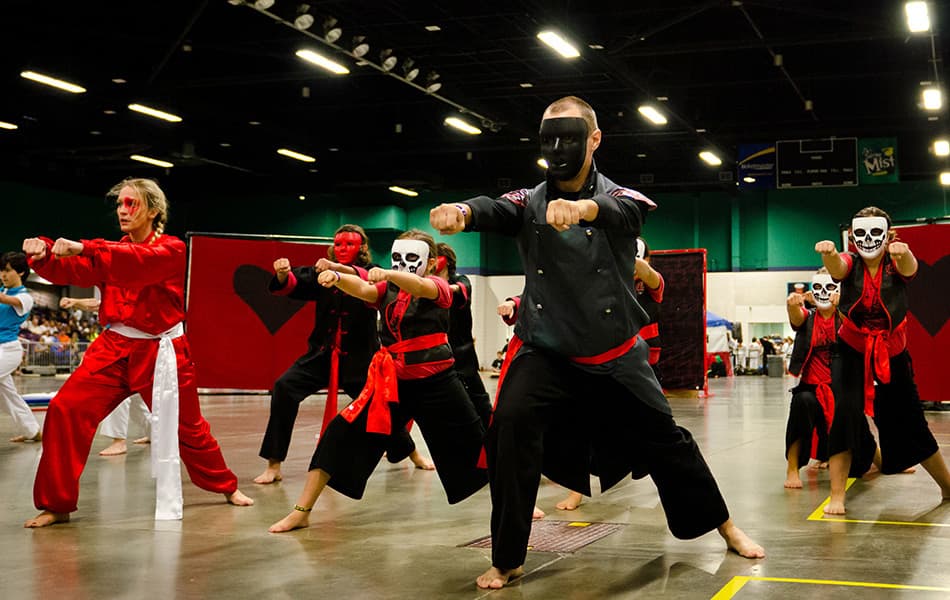
What creativity competition is
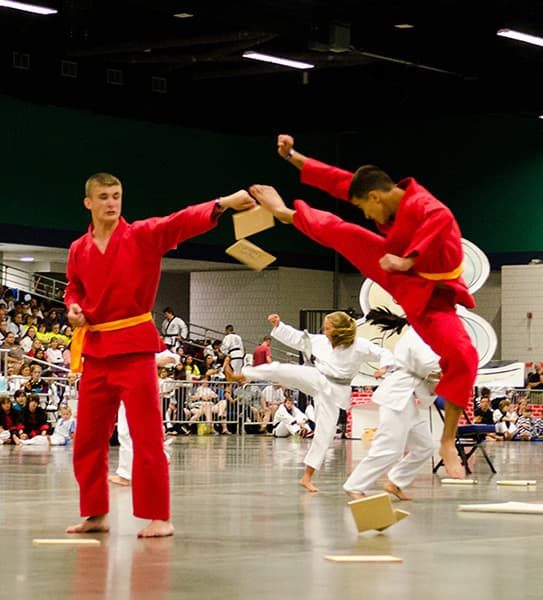
Creativity is open to the competitors' own interpretation — self-defense, one-step, three-step, breaking, weapons, and choreographed scenes are all examples of what a team might build a routine around. Common-sense safety practice is required throughout: nobody, including judges and spectators, should be put at risk. All general competition and hyung rules still apply on top of what follows.
Eligibility and time limit
- A studio unit (group) is accepted as a single applicant; there's no limit on the number of performers.
- Every member of the group must be a valid, registered WTSDA member at the time of the event.
- Sah Dan candidates are not eligible to compete — no matter how minor the role.
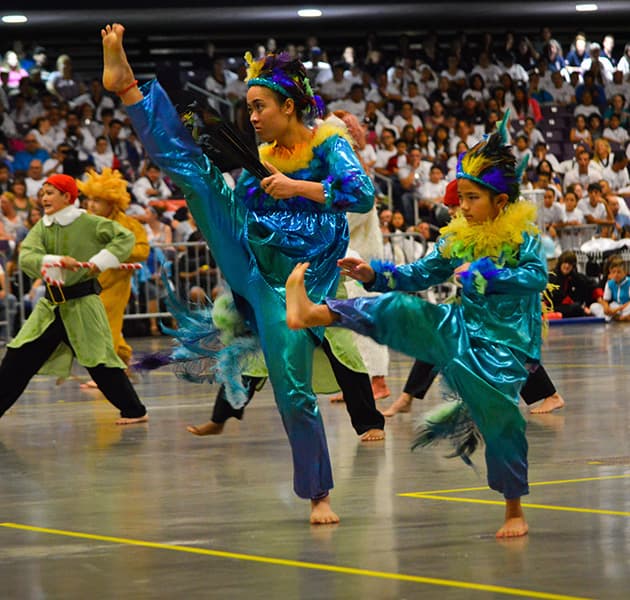
The actual performance gets five (5) minutes, not counting setup. The facilitator signals the start of time when the performance begins. Setup and clearing the floor are each capped at a maximum of 2 minutes by default, though an individual Championship can adjust that based on the venue.
Elimination and safety restrictions
An actual live performance is the ideal for every entry, but elimination by video submission or written description is possible under certain circumstances.
Additional restrictions or requirements can apply depending on the venue — specifics are described in the written material for each individual Championship.
Judging panel and scoring system
Each individual Championship sets the exact panel size, but it must fall between a minimum of five (5) and a maximum of ten (10) judges — larger than a typical hyung panel, to spread the judging load across a longer, more complex performance.
Scoring uses a two-tiered scale: judges first award a technical accomplishment score (5-to-10), then a separate creativity score (5-to-10), so every entry gets credit for both dimensions of effort.
- Technical merit
- Individual skill, teamwork, technical harmony, and success of performance (breaking, etc.).
- Creativity merit
- Meaning of the performance, costumes, decorations, music, lighting, and technical skill in areas outside Tang Soo Do.
Competition protocol
Team performances go in random order, determined by the head table. The protocol closely follows hyung competition, with a few differences:
- The panel can run from five up to ten judges.
- The scorekeeper announces studio names instead of calling individual competitors.
- Two scores are given for each performance, not one.
- A facilitator may be used to help organize teams and assist with ring management.
- Creativity teams are checked against the envelope's list. Anything missing or unlisted gets checked with the center judge, then the head table, before competition begins.
- The scorekeeper or facilitator announces the first team and the "on-deck" team in a loud, clear voice — studio names can sound similar. Each team gets up to 2 minutes to set up.
- The timekeeper sets the stopwatch for 5 minutes and starts timing on the facilitator's signal, with a 30-second warning given to the team. If a team goes over, the timekeeper tells the facilitator, who tells the center judge — the team still receives its earned scores but is disqualified.
- At the end of the performance, the center judge confirms all judges are ready and calls for the technical merit score first. The scorekeeper or facilitator announces each technical score aloud, decimal included.
- Immediately after, the center judge calls for the creativity score the same way. Each team then gets up to 2 minutes to clear props and clean up — exceeding that limit also disqualifies the team.
- Repeat for every team.
Calculating scores and results
Two scores are recorded per team: one for technical merit, one for creativity. For each of the two categories, the highest and lowest scores are dropped, and the rest are totaled. A minimum of five technical merit scores and five creativity scores should be used — so on a five-judge panel, every score counts. Disqualified teams' scores aren't tabulated at all.
The top four scoring teams win 1st, 2nd, 3rd, and co-3rd place. If there's a tie, the dropped scores get added back in. If a tie still remains — or the panel had five or six judges — the team with more participants wins the award.