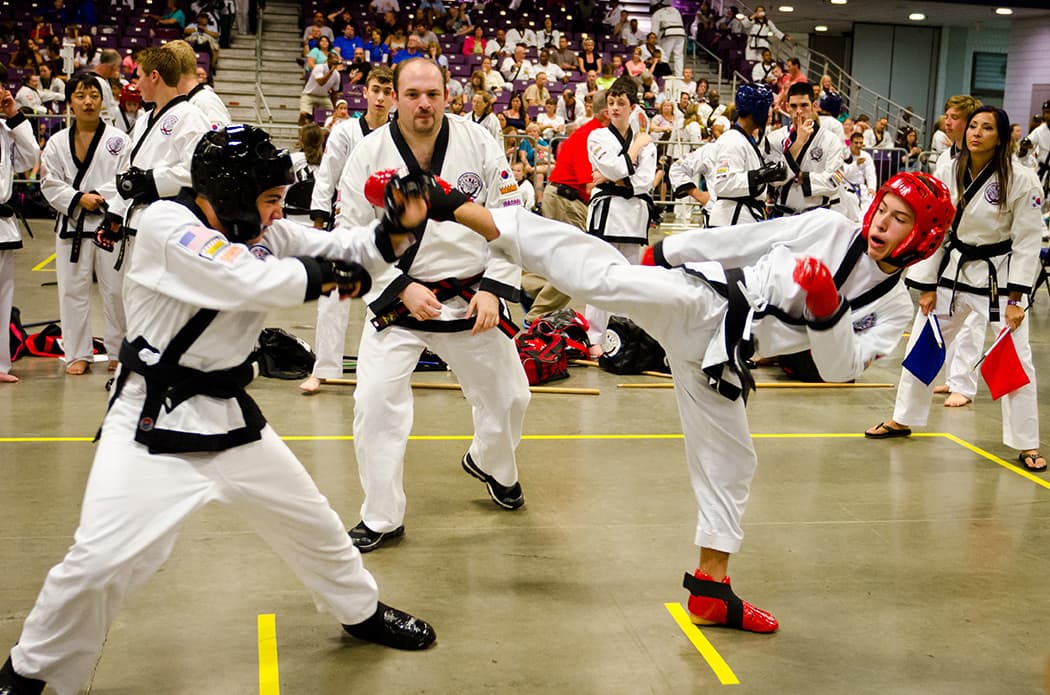
Dae Ryun Competition Protocol
Match flow, the bye-out bracket system, and match time rules.
Official duties specific to dae ryun
All general competition rules apply. Dae ryun adds its own ring-staff responsibilities on top of them.
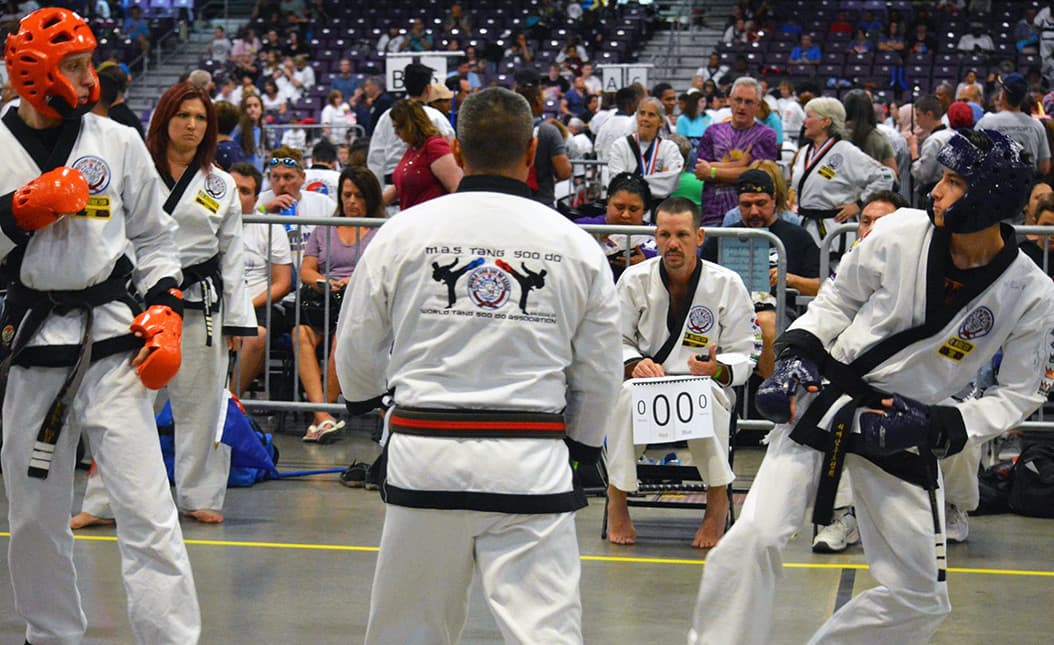
- Center judge
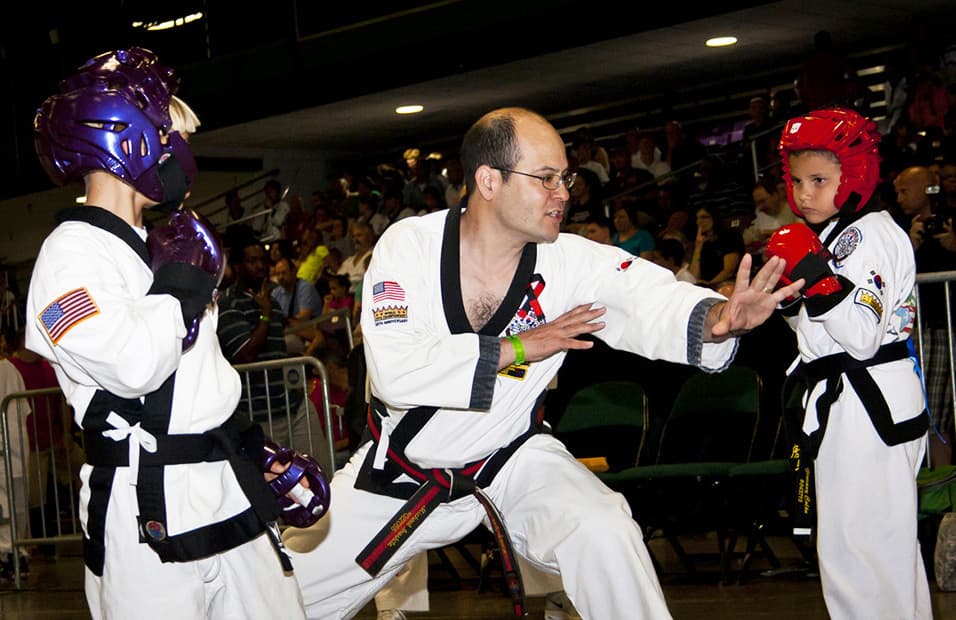
- Receives the ring assignment and equipment from the head table and ensures it's returned afterward. Completely controls the match: physically inspects competitors before the match for required equipment and no prohibited items, gives full rule instruction to competitors and ring staff, controls all ring staff, and declares the beginning, end, cautions, warnings, point deductions, disqualification, and the winner. Works with the corner judges and scorekeeper to set up the bye-outs and matches on the score sheet.
- Corner judge
- Positioned in a corner of the ring; assists the center judge when necessary, calls points and penalties at the appropriate times, and helps with the dae ryun score sheet.
- Scorekeeper
- Sits at ringside in sight of the center judge, organizes competitors on the dae ryun score sheet, keeps score, and keeps the winner's record for the matches.
- Timekeeper
- Sits ringside next to the scorekeeper and keeps time per regulations.
- Arbitrator
- Same duties as in the hyung section.
Appearance and safety gear
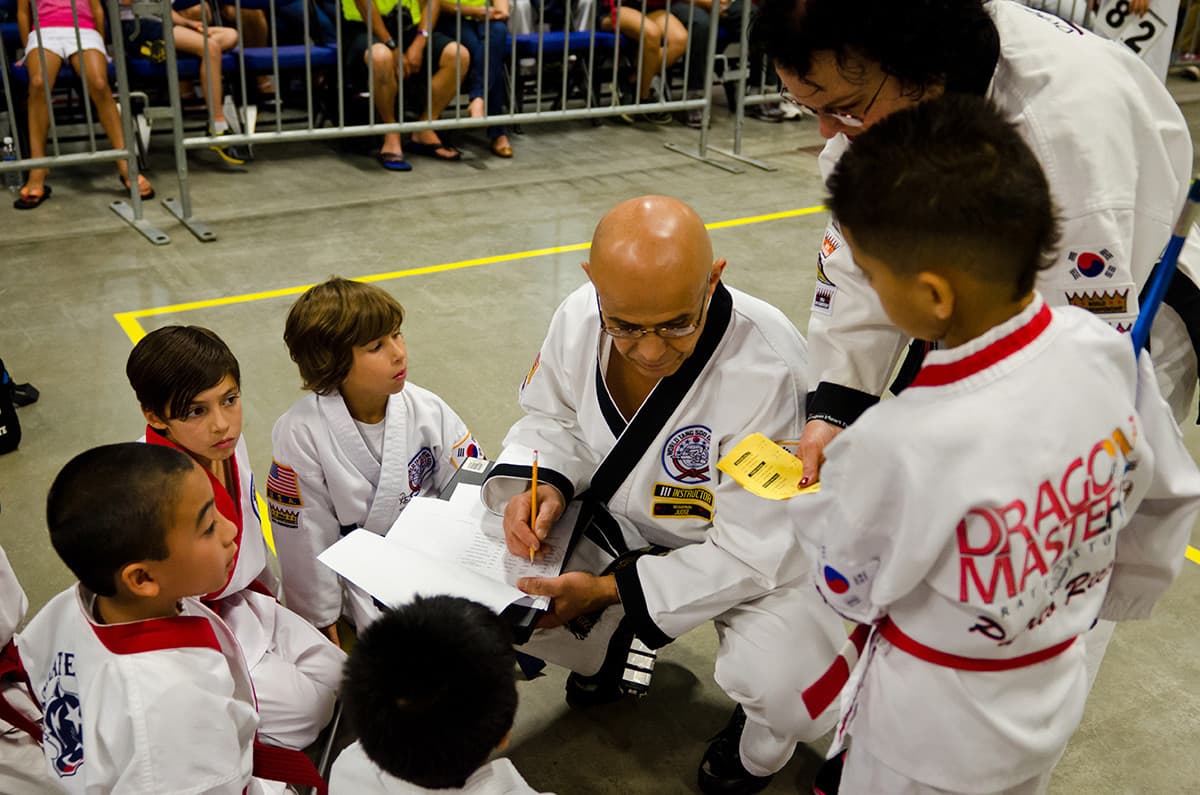
Competitors wear clean, pressed traditional Tang Soo Do dobohk. The center judge or arbitrator will reject any contestant wearing illegal dobohk or inappropriate belts.
- Foam-based safety protection covering fingers and toes is mandatory — open-toed and open-finger equipment is not allowed.
- Head, foot, hand, and mouth protection is required for all competitors.
- Male competitors must also wear groin protection under their dobohk.
- Additional safety equipment is optional but must be approved by the center judge or arbitrator.
- No jewelry of any kind is allowed, for the safety of all contestants.
Competition protocol, start to finish
- As soon as all ring staff and competitors report to the ring, the scorekeeper checks everyone against the envelope's list — mismatches get checked with the center judge, then the head table.
- The center judge uses the bye-out system to determine the number of bye-outs and the first-round matches, pairing competitors as close as possible by size and avoiding same-studio matchups where possible.
- The scorekeeper collects competition cards and records first-round competitors' names on the leftmost numbered lines of the score sheet. Bye-out competitors are recorded on the 2nd-round bracket, since that's when they'll spar.
- While the scorekeeper sets up the sheet, the center judge physically inspects competitors and requires removal of jewelry or other prohibited equipment.
- All competitors in the division line up and kyung yet to the panel of judges.
- The center judge briefly instructs and reminds competitors of the rules, then has them sit quietly behind the line outside the ring.
- The scorekeeper calls the first pair and announces the next "on deck" pair in a loud, clear voice, pointing to which side each competitor should stand on (red/blue ribbons in the belt can help distinguish them).
- The timekeeper sets the stopwatch to 2 minutes. The clock starts when the center judge commences the match and runs continuously until the center judge tells the timekeeper to stop it — it isn't paused every time the fighters stop.
- The center judge commands "Face here, cha ryut, kyung yet, face each other, kyung yet." Competitors shake hands and step back to Dae Ryun Choon Bee while the center judge steps between them.
- Once ring staff are ready, the center judge calls "Shi Jak" and steps clear. The timekeeper starts time on this command.
- To stop the match — for a scored point or an illegal action — the center judge calls "Jung Ji," or a corner judge shouts "Call" to prompt it. Warning calls are always resolved before points are polled and awarded.
- The match clock keeps running through a stoppage unless the center judge specifically says "stop time," at which point the timekeeper stops the watch.
- The scorekeeper records points and penalties as the center judge announces them, and may repeat the call to confirm it. The first competitor to reach 3 points wins.
- If time runs out before either competitor reaches 3 points, the timekeeper announces this loudly — the competitor with more points wins. A tie goes to overtime, continuing until the first point is scored or lost to a warning.
- Any point or penalty call made before time expires must be resolved before the match officially ends.
- The match ends when 2 minutes expire, 3 winning points are reached, or a competitor is disqualified.
- The center judge calls "Ko Mahn" (finished). Competitors resume position, kyung yet to each other, then face and kyung yet to the center judge.
- The center judge grasps both competitors' hands and raises the winner's hand to declare "Winner."
- Competitors kyung yet to the center judge, shake hands, and are dismissed from the sparring line.
- The winner confirms with the scorekeeper that their name is recorded correctly, and the process repeats until the final round is complete.
The bye-out system
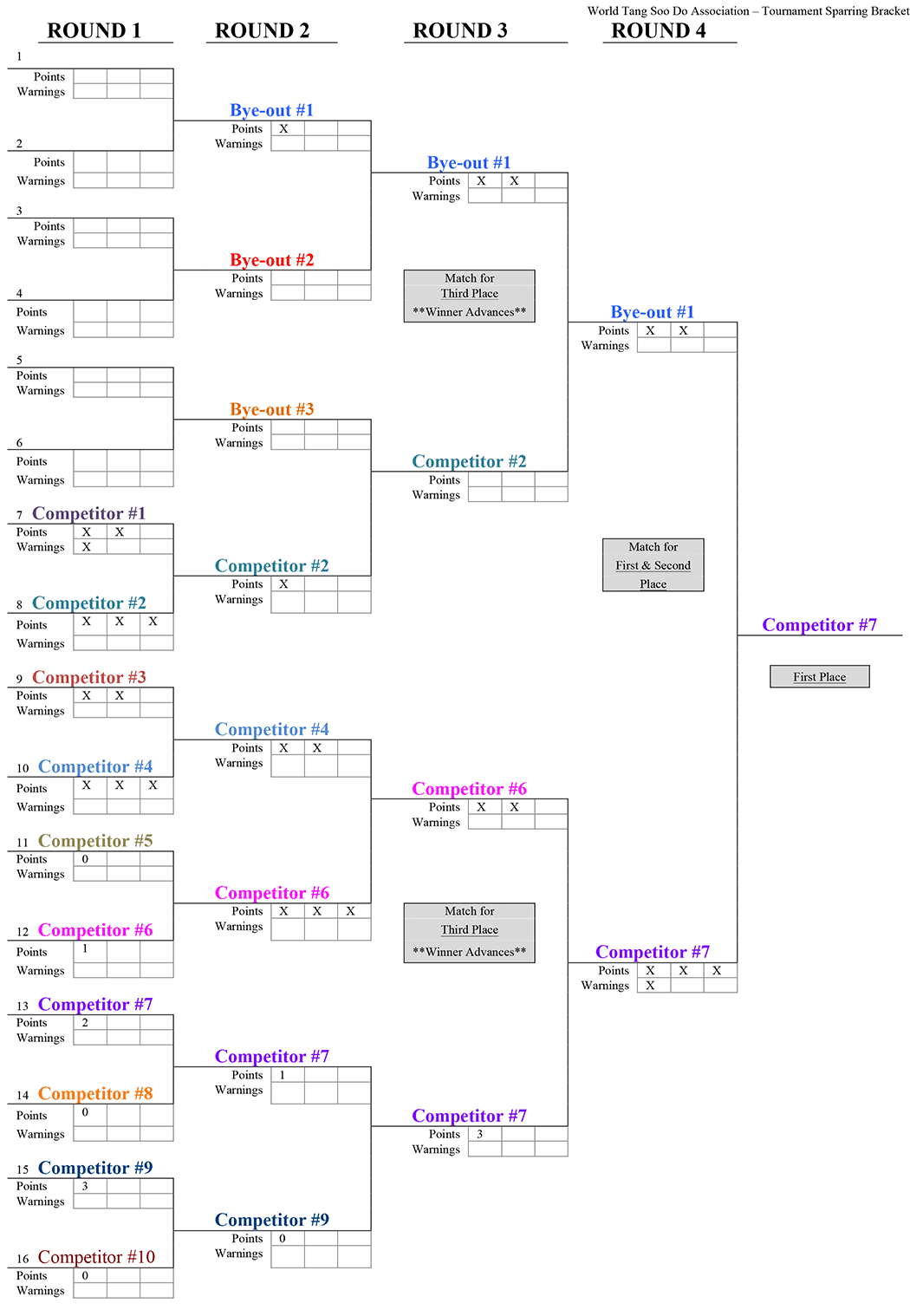
The bye-out system is required — it eliminates any odd number of competitors in a round and prevents a final round-robin decision. The number of competitors in a division determines the number of bye-outs from the chart below, and bye-out recipients are chosen randomly, keeping first-round matchups clear of same-studio pairings and matched by size.
| Competitors | Bye-outs |
|---|---|
| 3 | 1 |
| 4 | 0 |
| 5 | 3 |
| 6 | 2 |
| 7 | 1 |
| 8 | 0 |
| 9 | 7 |
| 10 | 6 |
| 11 | 5 |
| 12 | 4 |
| 13 | 3 |
| 14 | 2 |
| 15 | 1 |
| 16 | 0 |
| 17 | 15 |
| 18 | 14 |
| 19 | 13 |
| 20 | 12 |
| 21 | 11 |
| 22 | 10 |
| 23 | 9 |
| 24 | 8 |
| 25 | 7 |
| 26 | 6 |
| 27 | 5 |
| 28 | 4 |
Worked example, starting from 13 competitors: the chart gives 3 bye-outs, so 3 competitors are randomly removed from the first round, leaving 10 to spar. After round 1, 5 winners join the 3 bye-out competitors for round 2 — 8 total. After round 2: 4 remain. After round 3: 2 remain, and the two round-3 losers automatically place 3rd and co-3rd without sparring again. After round 4 (the final): the winner takes 1st place, the loser takes 2nd.
Match time allowance and winning points
Every match runs 2 minutes, whether the division is Gup or Dan. Time isn't stopped every time competitors pause — only at the center judge's command, for things like an injury or a judges'/arbitrator's conference. The center judge should manage this carefully rather than abusing stoppages or constant conferences.
The winner is whoever reaches 3 points first within the 2 minutes, or has the most points when time expires. Warnings accumulated during the match carry over into overtime, which continues until the first competitor scores a point — or avoids losing one to a warning.