Points & Penalties
Legal targets, valid techniques, cautions, warnings, and disqualification.
Target area for valid points
- The front and sides of the body, above the belt but below the neck, are legal for both hand and foot techniques.
- The front and sides of the head and throat are additionally legal — but for foot techniques only.
- The back of the head is never a legal target.
Recognized offensive techniques
- Hand techniques
- Body only. Reverse punch, side punch, and front hand lunge punch are the only hand techniques allowed for scoring.
- Foot techniques
- Any kicking technique to a valid target area.
- Illegal techniques
- Boxing jab, hook, uppercut, and cross punches are not allowed. Techniques using the head, elbows, back fist, back wrist, fingers, spear hand, ridge hand, knee, toes, or knife hand are not allowed.
Scoring points
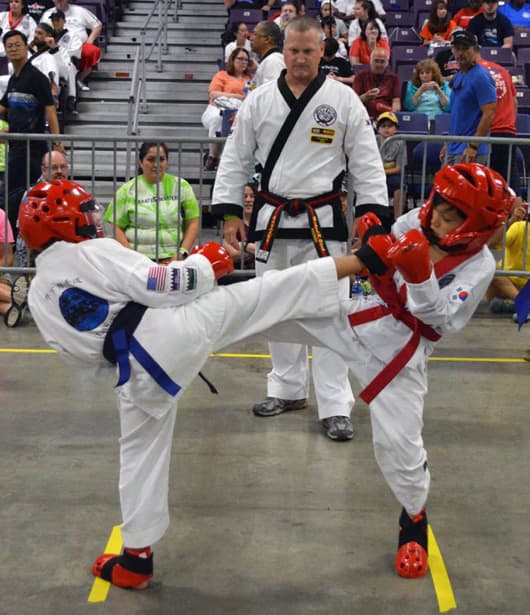
Points are called for techniques with correct form, distance, balance, focus, and control — not for contact. Skilled judges determine whether a technique meets the point criteria, using discretion about the distance required for children and beginners versus Black Belts.
- A foot or hand technique to an authorized area is worth one (1) point.
- Holding the opponent or falling on them after a legal attack does not score.
- A continued attack in clinching form does not score.
- If a competitor is fully outside the ring but the attacker has one foot in the ring and lands a legal technique before Jung Ji, the point can be awarded to the competitor with a foot in the ring — the competitor outside the ring can never score.
Contact
Judges use discretion on the distance required for different ranks to meet the point criteria — scored techniques should be controlled and not making contact with or touching the head or body. Actual contact or touching results in a penalty — a warning, point deduction, or disqualification, depending on severity. Both center and corner judges must act professionally, using this rulebook as their guide alongside common sense; arbitrators intervene when judges aren't enforcing no-contact.
Penalties
When any judge sees an illegal technique, they yell "Call," and the center judge stops the action. If a judge sees a penalty and a point at the same moment, they must signal the warning first. The center judge then polls the judges — majority rules. If only one judge calls a warning, there's no need to repoll; the center judge simply informs the competitor of what that judge saw. When a majority calls an infraction, the center judge resolves the penalty first, then calls for points. A judge who voted to warn a competitor cannot also give that competitor a point during the same stoppage — though they may still award a point to the opponent.
The center judge has four options, in increasing severity: caution, warning, point deduction, and disqualification. For a very serious offense, the center judge has the timekeeper stop time while judges confer before ruling.
Caution
A center judge may give a verbal caution when a majority of judges did not see an infraction.
Warning
A repeat of a previous verbal caution requires a warning call. Warnings apply to:
- Throwing/sweeping
- Stalling/running out of the ring
- Pushing techniques
- Attempting face contact
- Grabbing/holding
- Intentional falling/pretending pain or injury
- Escaping by showing back to the opponent or leaving the ring
- Deliberately attacking an unauthorized vital area
- Conduct unbecoming to the Tang Soo Do spirit by the competitor, instructor, or parent
- Using illegal techniques, including hand techniques to the face
Point deduction
- Two warnings to any competitor — not necessarily for the same technique — trigger a mandatory one-point deduction.
- More severe penalties can cause an immediate point deduction by MAJORITY judge decision, for: attacking a fallen opponent, contacting the opponent's face (intent isn't required), excessive contact, an intentional attack after Jung Ji is declared, attempting an unauthorized technique (head-butting, kneeing, biting, gouging, etc.), or conduct unbecoming to the Tang Soo Do spirit.
Disqualification
A disqualified competitor loses that match; in early rounds they're simply eliminated, but in final matches they're still entitled to 2nd place or co-3rd place. Beyond the 3 strike-out rule, a competitor can also be disqualified by a UNANIMOUS judge decision for: excessive contact, injuring the opponent with a malicious attack, misconduct against a judge, conduct unbecoming to the Tang Soo Do spirit, unbecoming conduct by a parent or instructor, or injury to the opponent involving blood or extreme redness.
Handling injury
When a contestant can't continue due to injury, the party responsible for the injury is disqualified. If the injury isn't the other contestant's responsibility, the judges confer and decide the winner by majority vote — that decision is final.
Determining points
Every judge in the ring gets one vote toward the score.
- R
- 1 point to Red.
- B
- 1 point to Blue.
- O
- Did not see — the judge couldn't determine if a point or warning was scored due to their positioning. This vote doesn't count toward that stoppage's decision.
- N
- No point — neither competitor scored.
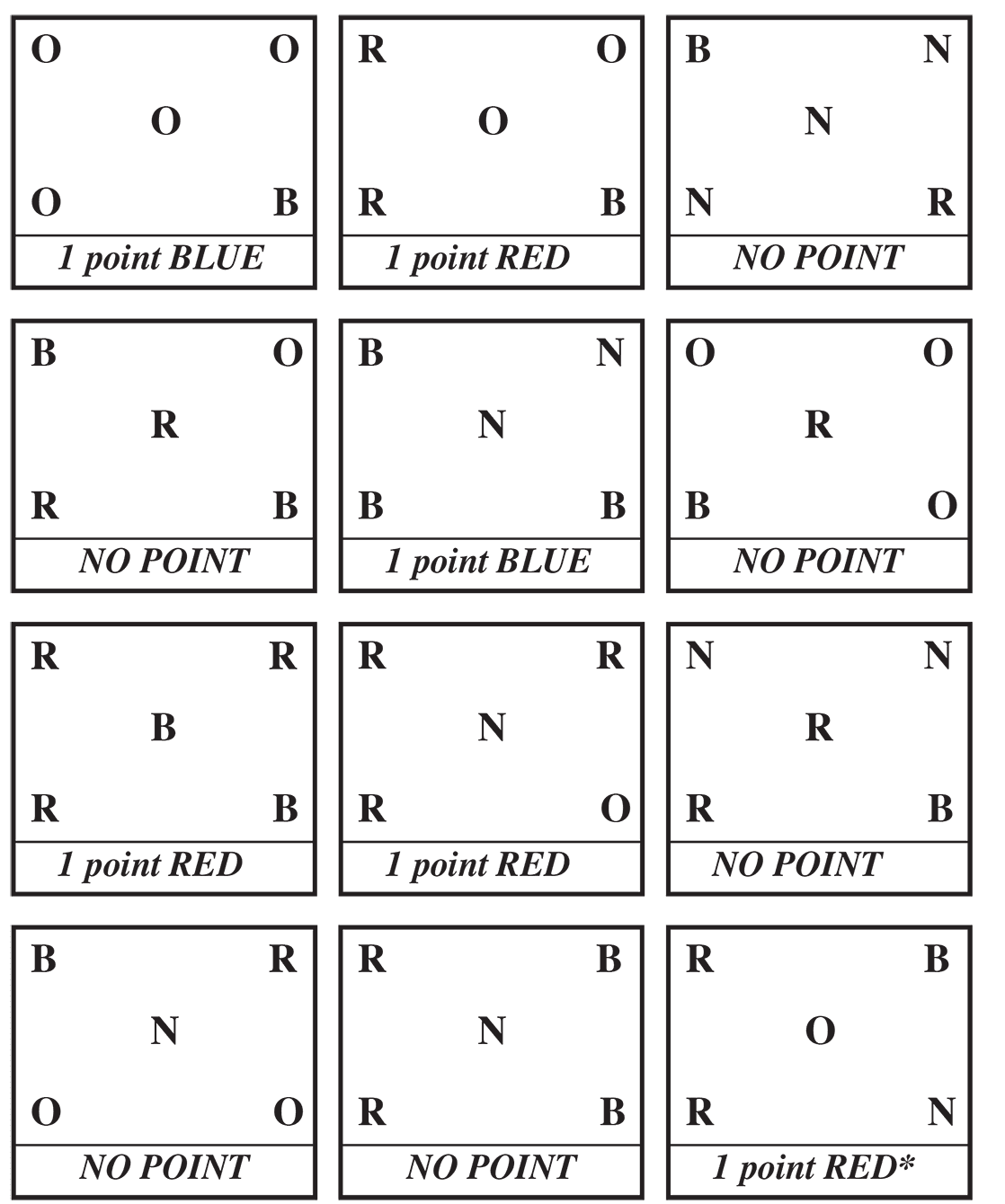
The difference between 'did not see' and 'no point' matters: 'did not see' is used when the center judge or the opponent blocked a judge's view of the action, while 'no point' is used when neither competitor scored, or a simultaneous exchange (clash) occurred. Most scenarios resolve simply, but the asterisked example above works like this: the 'did not see' vote is set aside, leaving 4 judges — two voted red, one voted blue, and one voted no point. The no-point vote cancels one red and one blue vote, leaving a net gain of one vote for red.
Results and awards
Upon completing the final round in an assigned ring, the center judge verifies the scores and all information the scorekeeper has written on the sheet, following the same results and awards protocol described in the hyung competition section.