Scoring & Deductions
Performance criteria, the point scale, and mandatory restart deductions.
Performance criteria
Judges must give every competitor their full, undivided attention and score impartially. The rulebook lists these as the criteria to weigh:
- Understanding of hyung
- Skill of hyung execution
- Degree of perfection, according to the individual's age and physical condition
- Degree of difficulty in performing the hyung
- Contestant's attitude
- Rhythm and feeling put into the hyung
- Speed and coordination of techniques
- Balance, power, and focus

The point scale
| Score | Meaning |
|---|---|
| 10 | Perfect |
| 9 | Excellent |
| 8 | Good |
| 7 | Average |
| 6 | Below average |
| 5 | Poor |
Mandatory restart deductions
A competitor who makes a mistake may request a restart — but it always costs points.
- Every restart costs a mandatory 0.5-point deduction from the score, regardless of rank.
- No more than two restarts are allowed — three total tries (the first attempt plus two restarts).
- If the third attempt still fails, the contestant receives the lowest possible score: 5.0.
- Equipment failure that forces a restart still requires the mandatory deduction.
- Before calling for scores, the center judge announces that the score reflects a restart deduction.
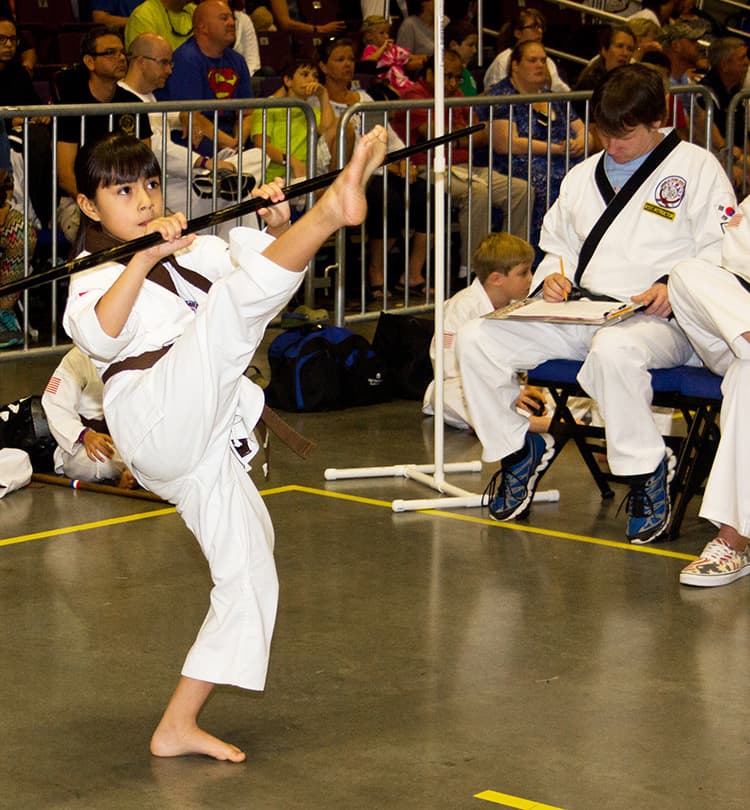
Calculating the final score and standings
The scorekeeper's job is to record and calculate accurately — not to watch each performance — tallying scores immediately after they're announced, while the next competitor is already performing.
- Three-judge panel: all three scores count toward the total.
- Five-judge panel: the highest and lowest scores are dropped, and the remaining three are totaled.
The top four scoring competitors win 1st, 2nd, 3rd, and co-3rd place. For a five-judge panel tie, the dropped high and low scores are added back in to break it. If a tie remains — or the tie happened on a three-judge panel — the tied competitors repeat the same hyung one at a time (order decided by a coin flip). If they're still tied after that, each judge simply points to the competitor they believe performed better, and the majority wins.