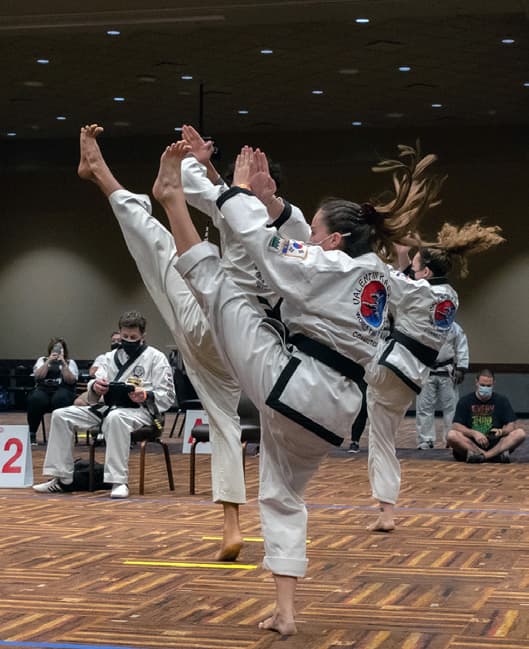
Team Hyung Competition
Rules for three-person synchronized form performances.
Team composition
Team Hyung follows the same rules as individual hyung competition, with a few team-specific additions. Individual Championships may add restrictions — how many teams a single studio can enter, age or rank groupings, or a cap on total teams — but those details must be spelled out in the registration materials.
- Each team consists of three members, of any age or gender.
- Gup members and Dan members must compete in separate divisions.
- Team Hyung divisions do not earn points toward the Championship cups.
What a team may perform
A team may only perform a traditional WTSDA empty hand hyung from the permitted hyung list — and specifically, the highest hyung allowed for the team's most junior member, or anything lower. For example, a team made up of an 8th gup, a 5th gup, and a 3rd gup is only permitted to perform Sae Kye Hyung Il Bu, Sae Kye Hyung E Bu, or Sae Kye Hyung Sam Bu — whatever the 8th gup member qualifies for.
Performance and judging criteria
Each judge scores the team's performance on the same 5-to-10 scale as individual hyung, weighing technique, accuracy, presentation, synchronicity, artistic quality, and intensity.